
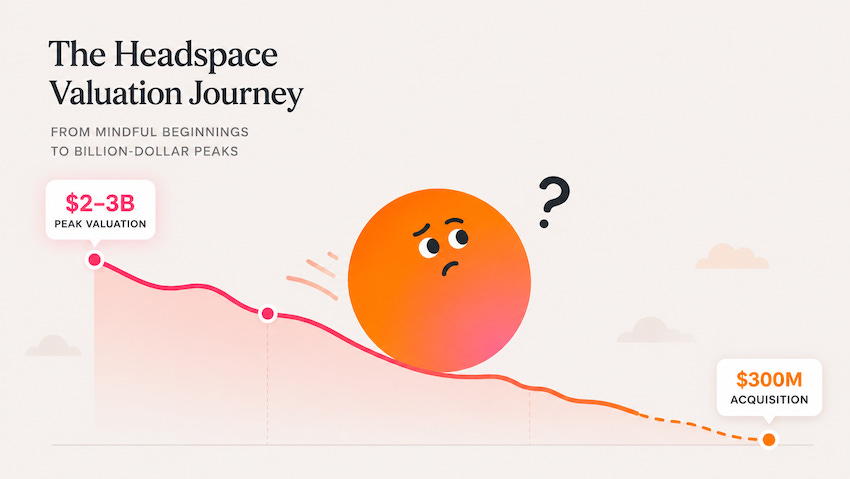
Headspace is being acquired by Sword Health in an all‑cash deal valued at $200–300 million, with completion expected around 14 September 2026. The buyer is a digital therapeutics company that began in virtual physical therapy and has been expanding into mental health. The acquisition is framed as a way to add Headspace’s meditation, therapy and psychiatry services to Sword’s employer and health‑plan offerings.
The price represents a steep drop from Headspace’s peak. The company was valued at roughly $3 billion in 2021. So the sale is at about 90% below that prior headline valuation.
Headspace metrics: revenue, subscribers, profitability
Public, audited financials for Headspace are limited, but recent estimates and app‑store data give a directional picture:
Revenue:
One 2025 estimate puts Headspace at roughly $140 million in annual revenue (ARR). (source: getlatka). Other sources describe last disclosed revenue around ~$300 million/year at the time of the 2021 Ginger merger, with no clear official number since.
App‑store data suggest the consumer iOS app alone generates on the order of $39–40 million per year in subscription revenue.
Users / subscribers:
Headspace has reported ~100 million “customers” cumulatively since launch, though this is a broad, lifetime metric rather than active paying subscribers.
Recent app analytics estimate ~2.6 million monthly active users (MAU) and ~431,000 daily active users (DAU), with lifetime downloads around 84.7 million.
Exact current paying subscriber counts are not publicly disclosed; the business mix includes direct‑to‑consumer subscriptions plus B2B (“Headspace for Work”) and clinical/health‑plan contracts from the Ginger merger.
Profitability:
There is no clear public confirmation that Headspace is profitable. Industry coverage emphasizes the valuation collapse and revenue decline rather than positive earnings, and the company has taken on significant debt (including a $105 million debt round in 2023), which typically signals ongoing cash needs.
Funding raised and prior valuations
Headspace’s capital history shows heavy fundraising before the sale:
Total raised: Estimates vary by source and what is counted (equity vs debt), but disclosed totals are in the $320–410 million range, including multiple equity rounds and later debt financings.
Equity before the 2021 merger is often cited around $177–211 million, with additional debt (including a $105 million loan in July 2023) pushing total capital higher.
Previous valuation:
In August 2021, Headspace merged with teletherapy provider Ginger, creating “Headspace Health” with a ~$3 billion valuation.
Prior to that, Headspace’s standalone valuation was reported around $1.8 billion, while Ginger had reached roughly $1.1 billion earlier in 2021.
Conclusion
Headspace’s sale to Sword Health for $200–300 million crystallizes a sharp correction from its $3 billion 2021 peak, reflecting slower growth, revenue pressure, and a tougher digital‑health funding environment. Multiple on revenue was likely around 1.5-2.0x. While it still commands a large cumulative user base and meaningful B2B relationships, the lack of clear profitability and the need for substantial debt financing help explain why a strategic buyer focused on employer and health‑plan channels is acquiring the asset at a fraction of its former valuation.